 Kaminofinance
 liquidity vaults - Range Choices and Costs
Kaminofinance liquidity vaults automate concentrated liquidity on Solana, with range width affecting fee potential and rebalancing costs. Narrower ranges concentrate capital near the trading price while they’re active. Wider ranges generally tolerate larger price moves before a range exit. To isolate range width, compare strategies for the same token pair alongside trading volume, pool fee tier, conversion costs and performance relative to holding the assets.
Automation handles token conversion, reinvestment and range adjustments. The vault strategy determines where liquidity sits and when it moves. Those operations affect the assets backing each kToken, so a fee figure alone doesn’t describe the position’s return.
Narrow and Wide Ranges in the Same Pool
Range width trades fee density against time in range, with comparable pool conditions helping isolate its effect. A concentrated liquidity market maker, or CLMM, assigns liquidity to a bounded interval of pair prices. Trading fees accrue to liquidity that’s active at the swap price. The same starting asset value can therefore produce different fee exposure when the ranges differ.
Narrow Ranges
A narrower range increases capital efficiency while price remains inside its bounds and can produce more trading fees per dollar deployed, with actual income also reflecting volume and competing liquidity. Smaller relative price moves can push it out of range. Repeated exits can prompt further adjustments, each potentially involving swaps. The additional fee income has to cover those execution costs and the position’s changing performance against the same assets held outside the pool.
Wide Ranges
A wider range spreads capital across more possible trading prices, generally reducing fee density per dollar. Its greater width can accommodate larger price movements before a range exit. Fewer exits can reduce how often the strategy incurs rebalance costs. A quieter price path can favor staying narrow, whereas frequent movement across tight boundaries can make wider placement more competitive.
Single-Token Deposits and kToken Shares
Single-token deposits enter a two-asset liquidity position through an automatic conversion into the ratio that the pool requires. Kamino Swap converts the necessary portion before the vault deploys the assets. Slippage and decentralized exchange (DEX) fees can apply to that conversion, even though the deposit begins with one token. The vault issues kTokens representing a proportional share of its liquidity position. Each receipt represents exposure to the underlying holdings, including changes in their composition. A single-token entry doesn’t make the resulting investment a single-asset position.
The kToken exchange rate measures the underlying assets represented by each receipt token. A receipt-token balance represents your proportional share of the vault’s assets; valuing it also requires the current underlying assets and their prices.
What Happens When the Price Leaves the Vault’s Range?
A concentrated liquidity position outside its selected range earns no pool trading fees. Kamino’s automated bots manage rebalancing under the vault’s configured strategy. For a strategy that rebalances on range exit, they close the existing position and open a new range around the trading price. That process restores active fee exposure when the new range contains the price.
Rebalancing can require conversion between the pool’s assets to establish the ratio for the new range. Swaps introduce execution costs while the reopened position continues to hold changing proportions of the assets. Reopening around a new price doesn’t recover losses that have already accumulated. A later price move can require another adjustment, so volatility affects both range activity and operating costs.
Vault Charges, Swap Costs and Solana Transaction Fees
Execution costs arise when assets need conversion or an on-chain transaction needs processing. They’re distinct from the trading fees that liquidity providers earn. A range comparison needs entry, rebalance and redemption costs, plus applicable liquidity-vault performance and withdrawal fees. Don’t subtract a charge again if the reported income already includes its deduction.
DEX Fees and Slippage
DEX fees apply to swaps through the pools used for conversion, while slippage describes the difference between the anticipated execution price and the price achieved. Both can affect conversions used for deposits, range adjustments and single-token withdrawals. Pool liquidity, the amount converted and prices available at execution drive the cost. A narrow range doesn’t specify a fixed rebalance charge, because different price paths can require different numbers and sizes of conversions.
Costs Across Rebalances
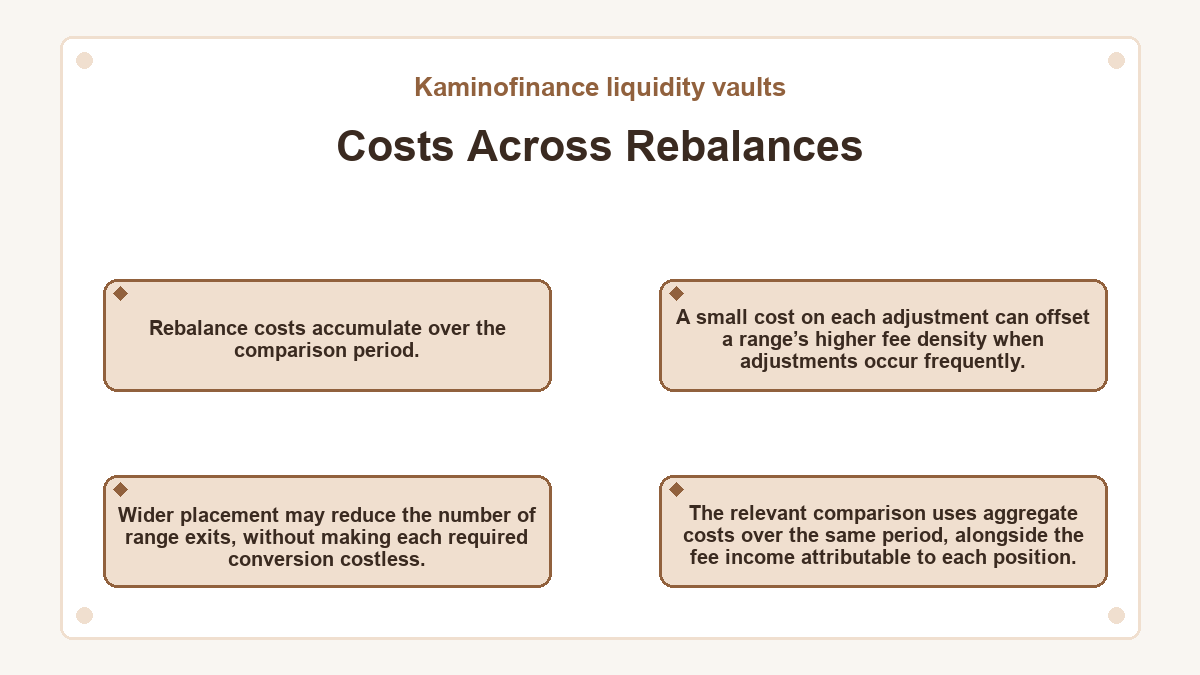
Rebalance costs accumulate over the comparison period. A small cost on each adjustment can offset a range’s higher fee density when adjustments occur frequently. Wider placement may reduce the number of range exits, without making each required conversion costless. The relevant comparison uses aggregate costs over the same period, alongside the fee income attributable to each position.
Network Processing
Solana transaction fees are payable in SOL and include a base fee plus an optional prioritization fee. They’re separate from DEX fees and slippage. Automatic harvesting removes the need for manual harvest transactions; that convenience doesn’t mean every vault operation has zero execution cost.
Compounding and the Value Behind Each kToken
Automatic compounding reinvests trading fees and earned rewards net of applicable performance fees into the liquidity position at regular intervals. Additional assets increase the backing of each kToken relative to a position without that reinvestment. The exchange rate reflects the assets that each receipt represents. It doesn’t establish a fixed dollar return. Market movements, changes in token composition and execution costs still affect what those assets are worth. Comparing compounded positions therefore requires both share accounting and asset valuation across the same measurement period.
Compounding also changes the capital available for later trades. More deployed capital can earn further fees when it’s in range, while the position remains exposed to the pair’s relative price movements.
Impermanent Loss Against a Holding Benchmark
Impermanent loss measures the holding-relative shortfall caused by a liquidity position’s changing asset mix. The benchmark holds the same original assets through the same price changes. A liquidity provider (LP) holds a changing mix of the pool’s assets as swaps move the relative price. Concentrating liquidity makes that redistribution more sensitive to price movement. Automation manages placement and reinvestment while this exposure remains part of the position.
Fee Income Versus Holding
A liquidity position can outperform holding when earned fees exceed its holding-relative shortfall and relevant costs. Gross trading-fee income alone doesn’t settle that comparison. The holding benchmark preserves the original asset quantities, so comparing it with an LP position that began with a different mix would also measure the effect of choosing different assets.
Dollar Profit and Relative Performance
An LP position can increase in dollar value while finishing behind the same assets held separately. It can also lose dollar value even when trading fees accrue. These describe different outcomes because one measures absolute value and the other compares alternatives. Withdrawal closes the comparison at the value actually realized, including any conversion used to deliver a single token.
Trading Volume and Competing Liquidity
Trading volume and the pool’s fee tier determine how much fee income swaps generate for active liquidity. Each in-range LP receives a share based on its liquidity at those trading prices. Higher volume can increase the fees available, while more competing liquidity reduces an individual position’s share. A tight range in a low-volume pool can produce less income than a wider range in a busier pool. Those are different market exposures, so the comparison can’t attribute the difference solely to range width.
Volume and volatility can change independently. A busy pool can earn substantial fees during price swings, while low activity offers little fee income to absorb the same repositioning costs. Range width alone doesn’t reveal which combination will persist.
A Cost Boundary Between Two Range Strategies
A depositor in this hypothetical comparison wants to reconcile a completed-period result before adding capital. Both strategies use the same token pair and begin with identical asset allocations worth $1,347. All fee totals, execution costs and holding-relative shortfalls are assumed for the same period. Fee totals are net of performance fees, and the stated cost totals include any vault withdrawal fee. Each shortfall excludes fee income and execution costs so that the calculation counts them only once.
The narrower strategy earns $47 in trading fees, incurs $19 in total execution costs and finishes $17 behind holding before those items. Its net advantage over holding is $47 - $19 - $17 = $11.
The wider strategy earns $34 in fees, incurs $8 in execution costs and finishes $11 behind holding before those items. Its net advantage is $34 - $8 - $11 = $15.
The wider strategy finishes $4 further ahead of holding, despite earning fewer trading fees. The depositor selects it after reconciling the completed position’s fee and cost records. Missing execution costs would leave that selection unsupported.
The narrower strategy would tie at $51 in fee income if every other input stayed unchanged. Above that amount, it would lead. A different cost total or holding-relative shortfall moves that boundary.
Single-Token Withdrawals and Conversion Costs
Single-token withdrawals can convert the position into one token through auto-swap, with DEX fees and slippage affecting delivery. The assets available for that conversion reflect the pool’s composition at exit. That composition can differ from the deposit ratio or an earlier range cycle. Converting the final holdings doesn’t reverse the economic effect of earlier swaps. Any conversion used at exit contributes to the position’s realized return. A fee comparison ending before withdrawal can therefore omit costs needed to obtain the selected output.
A redemption quote estimates the token output after conversion. The completed redemption establishes the amount received. The vault valuation includes your share of both invested liquidity and assets held outside the pool before conversion. Keeping these amounts separate prevents an execution expense from being counted as impermanent loss.
Liquidity Vaults and Lending Vaults
Liquidity vaults earn from market-making positions, while lending vaults earn borrower interest through reserve allocations. A lending reserve’s utilization, protocol interest spread or fixed-term withdrawal queue doesn’t describe a CLMM price range. Lending-vault management fees also belong to their own configuration. The shared word vault and the use of receipt shares don’t make those economics interchangeable. A comparison of automated LP strategies needs the selected pool’s fee income, conversions and asset exposure; an Earn-vault rate measures a different lending arrangement.
LP Exposure With Collateral-Backed Debt
Eligible liquidity-vault kTokens can serve as collateral in Kamino Lend, enabling leveraged liquidity provision. Debt adds interest, and an unhealthy borrowing position can become eligible for liquidation. Financing costs reduce the income left after liquidity-management expenses. Multiply also introduces borrowed exposure, with the asset and debt choices determining the risks of its particular strategy.
Fixed-rate borrowing can set the financing rate for a defined term, while variable-rate borrowing changes with utilization. Unrenewed fixed-rate debt must be repaid by maturity, and a first-term early-repayment penalty may apply. If debt finances either LP strategy, include interest, repayment charges and liquidation exposure in the comparison.
Kaminofinance liquidity vaults questions, answered
-
Who Sets a Managed Liquidity vault’s Price Range?
- The vault’s manager chooses and adjusts its range using volatility and fee data. Depositors hold proportional shares of the resulting LP position. Choosing a vault means selecting exposure to that shared strategy, including later range changes. It doesn’t give each depositor a separate interval inside the same position.
-
Does Fee Compounding Increase My kToken Count?
- Fee compounding increases the assets represented by each kToken, so the token count doesn’t need to rise. An unchanged receipt balance can therefore represent more underlying assets after the vault reinvests fees. The exchange rate captures that increase. The dollar value also depends on the prices of those assets, which can move independently of fee accrual.
-
Will an Automated Rebalance Restore My Original Token Quantities?
- An automated rebalance establishes the asset ratio needed for a new range using the position’s available holdings. Any earlier swaps have affected the asset mix, and conversion costs can reduce what’s available. The new range carries forward that economic outcome; reopening a position doesn’t reset its inventory to the quantities that preceded those operations.
-
Do Liquidity Rewards Continue for the vault’s Entire Lifetime?
- Liquidity rewards follow the campaign’s own duration and update rules, so incentives can change while a vault remains open. The CASH Growth Initiative announced on October 2, 2025 assigned rewards to an initial month and planned later updates. Those terms describe that campaign, not a permanent return from CASH-USDC liquidity. Trading-fee income and incentive income need separate treatment.
-
Does a Narrower Range Increase the Swap Fee That Traders Pay?
- A narrower range changes the concentration of an LP’s capital, while the pool’s fee tier determines the swap fee. Greater fee income per deployed dollar comes from the position’s share of active liquidity. It doesn’t mean traders pay a higher fee solely because that position uses tighter bounds. Comparing fee tiers and comparing range widths are different decisions.
Updated